Two worlds in one painting
How the Shanhai Map hides a second painting inside the first, and why the atelier now writes a private layer into commissioned works.
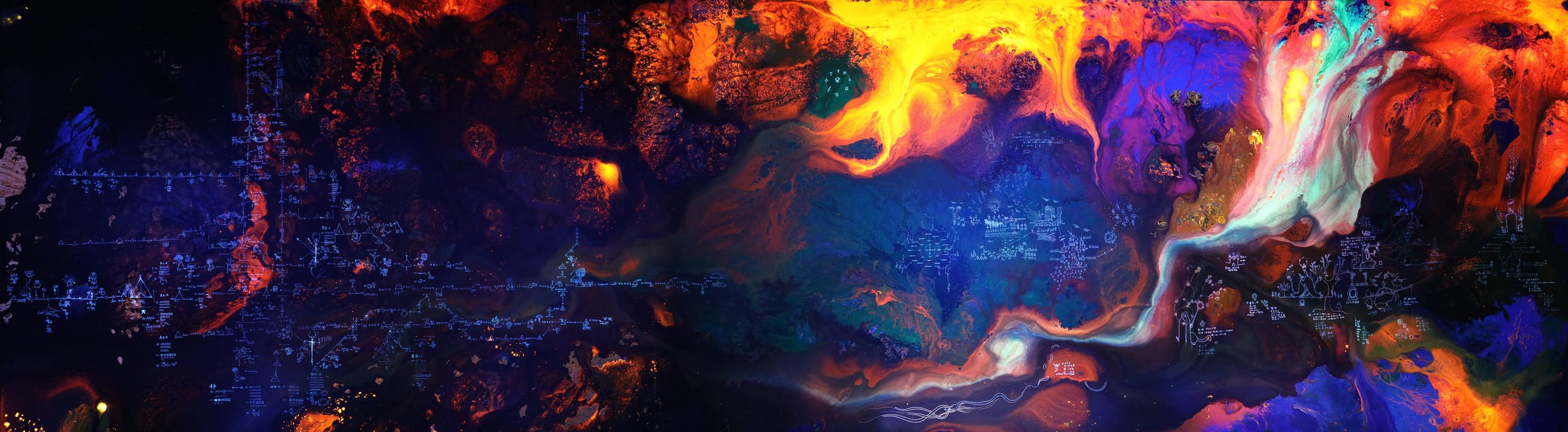
Under gallery light the Shanhai Map is a landscape eight metres long: ranges, seas, the weather of ore. The colours are mineral — malachite, cinnabar, azurite, ochre — and they hold light the way stone holds it.
Turn the light to ultraviolet and the surface withdraws. What rises in its place is notation: thousands of bronze-script characters, totems and diagrams that map the Classic of Mountains and Seas across the same canvas. The book's rivers run where the painted rivers ran. Its creatures sit where the colours suggested them.
If you see that all appearances are not appearances, you see the Tathāgata.
A method, not a trick
The two-state painting began as a way to keep research and image in one object. It has become something the atelier offers to clients: a work whose visible surface belongs to the room, and whose hidden layer belongs only to the owner — a genealogy, a founding date, the coordinates of a first house, a text a family reads at New Year.
The light that reveals it can be a lamp in a drawer, or a programmed cycle in a lobby that changes the room once an hour.
Related works